
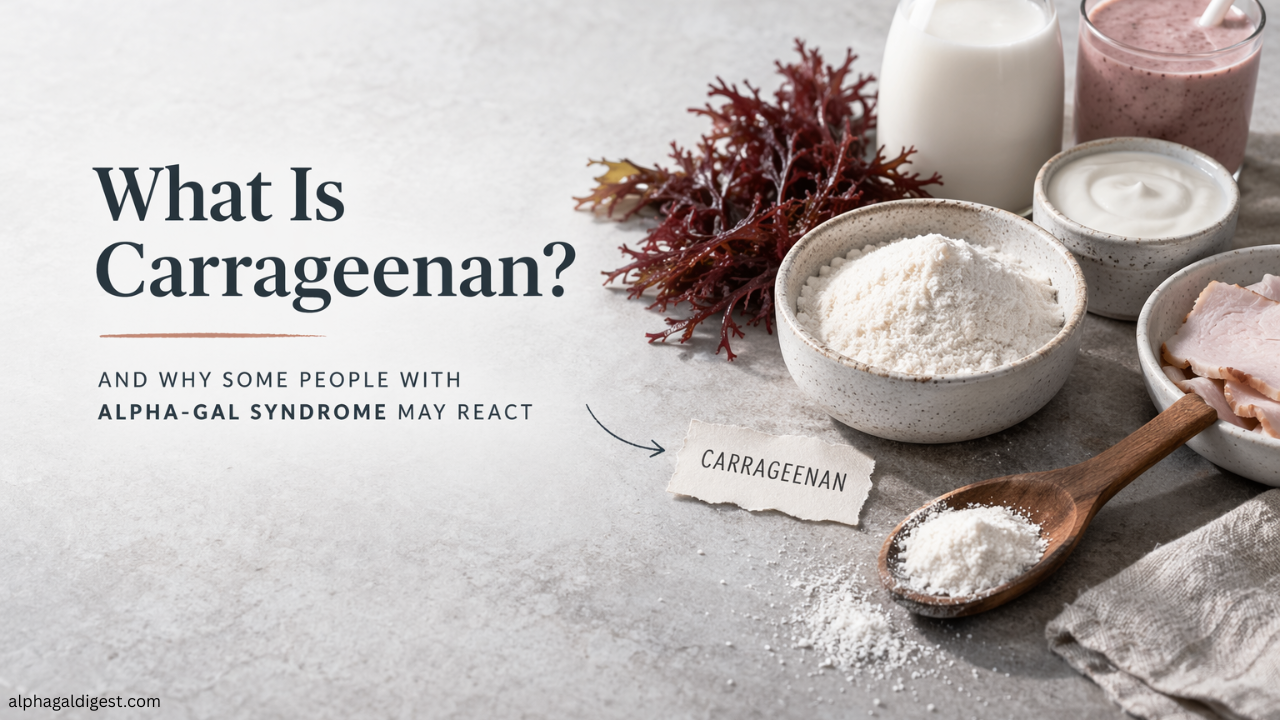
If you read ingredient labels often, you may have seen carrageenan listed in dairy-free milks, deli meats, whipped toppings, protein shakes, toothpaste, or ice cream. For many people, it is just another stabilizer or thickener. But for some people with Alpha-gal Syndrome (AGS), carrageenan can be an unexpected trigger. (Medical News Today)
This article explains what carrageenan is, how it is made, where it is used, and why some people with AGS try to avoid it.
Disclaimer
This article is based on information available at the time of posting and is meant for educational purposes only and not medical advice. Always do your own diligent research and consult your physician or allergist regarding personal triggers and safe food choices.

What Is Carrageenan?
Carrageenan is a family of natural carbohydrates (polysaccharides) extracted from certain species of red seaweed. It has been used for centuries in traditional foods, and modern food manufacturers use refined carrageenan because it helps create smooth texture, suspend particles, and prevent separation in liquids. (Medical News Today)
In practical terms, carrageenan helps:
- Keep chocolate milk from separating
- Improve creaminess in dairy-free milks
- Stabilize whipped toppings and ice cream
- Bind moisture in processed meats
- Create gel textures in desserts and puddings (Medical News Today)

How Is Carrageenan Made?
Commercial carrageenan is typically made by harvesting red seaweed, washing it, and extracting the useful polysaccharides with hot water and/or alkaline processing. The extract is then filtered, dried, and milled into powder for use in foods, cosmetics, and pharmaceuticals. Different processing methods create different functional types such as kappa, iota, and lambda carrageenan, each with different thickening or gelling properties. (Medical News Today)
This is different from simply eating seaweed as a whole food. Carrageenan used in products is a processed ingredient selected for its texture performance.

Where Is Carrageenan Found?
Carrageenan may appear in:
Foods
- Non-dairy milks and coffee creamers (almond, coconut, oat, soy)
- Ice cream and frozen desserts
- Yogurt and cottage cheese
- Deli meats and processed poultry
- Protein drinks and meal replacement shakes
- Whipped toppings
- Prepared foods and sauces (Medical News Today)
Non-Food Products
- Toothpaste
- Some medications or supplements
- Cosmetics
- Air freshener gels and household products (ScienceDirect)

Why Would People With Alpha-gal Syndrome React to Carrageenan?
Alpha-gal Syndrome is an allergy to the carbohydrate galactose-α-1,3-galactose (alpha-gal), most often associated with tick bites and reactions to mammalian meat or mammal-derived ingredients.
Carrageenan is noteworthy because published scientific discussion has identified that its molecular structure contains alpha-gal linkages. That means carrageenan is plant-derived, but it may still present a structure recognized by some alpha-gal antibodies. (Alpha-gal Information)
This may explain why some people with AGS report reactions after consuming products containing carrageenan.
How Common Are Reactions?
Not everyone with AGS reacts to carrageenan. In fact, many do not. However, AGS-focused educational resources report that at least a small percentage of patients appear to react, while real-world numbers may be underrecognized because carrageenan is often hidden in foods people assume are “safe.” (Alpha-gal Information)
Examples include:
- Dairy-free substitutes marketed as allergy-friendly
- Low-fat creamy foods
- Processed chicken or turkey products
- Protein drinks
- Toothpaste or medications (Alpha-gal Information)

What Do Reactions Look Like?
Reported reactions vary by person. Some people describe:
- Hives
- Itching
- GI distress
- Nausea
- Wheezing
- Rapid-onset reactions compared with delayed meat reactions
- Symptoms that seem “random” until ingredient labels are reviewed (Alpha-gal Information)
These reports are not the same as controlled clinical trials, but they are common enough in AGS communities that carrageenan is widely discussed as a probable trigger.
Why Carrageenan Can Be So Confusing for AGS Patients
Many people with AGS are told to avoid beef, pork, lamb, dairy, or gelatin. Carrageenan complicates that picture because:
- It is not mammal-derived
- It may still trigger some AGS patients
- It is common in foods chosen as “safe replacements”
- Symptoms may be blamed on dairy, soy, or another ingredient instead (Alpha-gal Information)
That means someone may think they react to almond milk, vegan ice cream, or deli turkey when carrageenan is the actual issue.
Should Everyone With AGS Avoid Carrageenan?
Not necessarily. AGS varies greatly from person to person. Some tolerate carrageenan with no problem. Others do better avoiding it.
A practical approach is:
- Discuss reactions with your allergist or physician
- Keep a food/symptom log
- Read labels carefully
- Trial elimination only under appropriate medical guidance, especially if you have severe reactions (Alpha-gal Information)

How to Spot Carrageenan on Labels
Ingredient labeling varies by product category, so reading labels each time matters.
Look for:
- Carrageenan
- Irish moss extract (less common)
- Seaweed-derived stabilizer language in specialty products
For a more in depth list, see my article about the Names for Carrageenan.
Bottom Line
Carrageenan is a seaweed-derived ingredient used to thicken, stabilize, and improve texture in many foods and consumer products. While some people tolerate it, some individuals with Alpha-gal Syndrome report reactions, likely because carrageenan contains alpha-gal-related carbohydrate linkages. If you have AGS and unexplained reactions to “safe” foods, carrageenan is worth discussing with your healthcare provider. (Medical News Today)
References
- Medical News Today. Carrageenan: Safety, risks, and uses. (Medical News Today)
- ScienceDirect Topics. Carrageenan overview. (ScienceDirect)
- Alpha-gal Information. Carrageenan: A Guide for People with Alpha-gal Syndrome. (Alpha-gal Information)
- Alpha-gal Information. Our Reactions to Carrageenan. (Alpha-gal Information)